Casselton ND Pole Barn Builders | Farm Buildings & Clear-Span Machine Sheds
Agricultural and residential post-frame buildings in Casselton and the central Cass County townships, on the county's best farming ground. Spans of 60 to 80 feet and doors sized for a combine with the header still attached are normal requests here rather than exceptional ones. Fargo ND Pole Barn Builders also builds across the rest of Cass County, North Dakota and Clay County, Minnesota.
Get a quote on your building
Tell us the size, the use and where the site is. We will come back with a scope and a price, not a brochure.
Casselton ND Pole Barn Builders
The grain town at the centre of Cass County farming
Casselton was founded on 8 August 1876, named for George Washington Cass, president of the Northern Pacific Railway, which established a station there to develop a town for homesteaders. It incorporated as a village in July 1880 and as a city in 1883, and it has produced five North Dakota governors, which is a remarkable record for a town of this size.
It sits at the centre of some of the best farmland in the state, at an elevation around 945 feet, slightly above the valley floor to the east. The work here is overwhelmingly agricultural, and the buildings are correspondingly large.
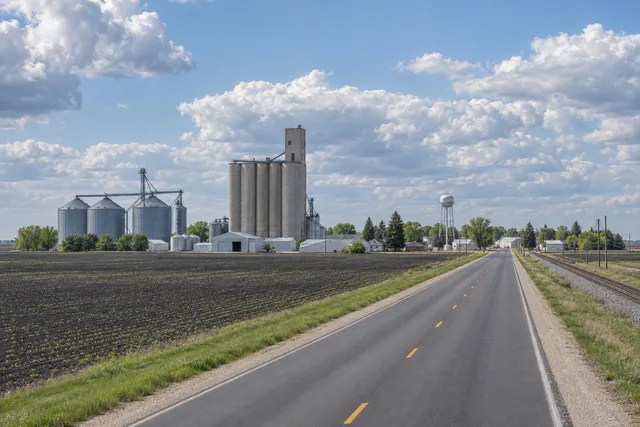
Casselton sits on the I-94 corridor with US 52 and ND 18 also running through, which makes it unusually well connected for a town of its size. For building work that means material delivery is straightforward and access is good almost year round, which is not true of every location in the county.
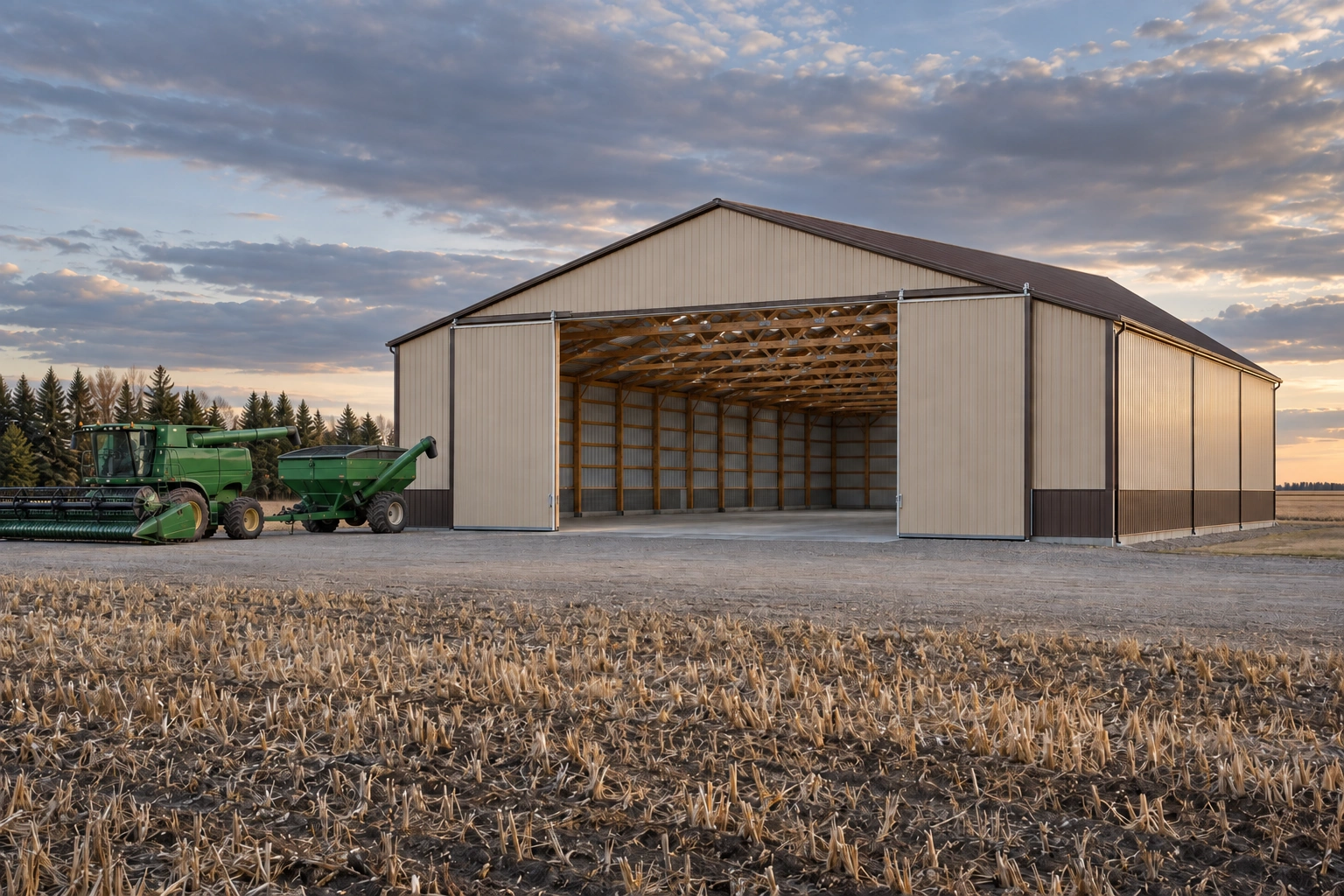
The farming operations around Casselton run large modern equipment, and the buildings reflect that. Clear spans of 60 to 80 feet and door openings sized for a combine with the header attached are normal requests rather than exceptional ones.
What we build around Casselton
Predominantly agricultural, at scale.
- Large machine sheds
Sized around modern equipment in transport position, frequently with a mix of open and enclosed bays on the same building.
- Grain and input storage
Buildings for seed, fertiliser and chemical storage, which have their own containment and ventilation considerations.
- Shops on farmsteads
Heated, wired for real equipment, where the farm does its own maintenance rather than sending machinery to town.
- Residential garages in town
Casselton has an established residential area with the usual demand for detached garages, permitted through the city.
Being exempt from the code is not being exempt from zoning
This comes up more around Casselton than anywhere else, because so much of the work is genuinely agricultural. NDCC 54-21.3-03 exempts buildings used exclusively for agricultural purposes on a farm from the state building code. It says nothing about setbacks, watercourse disturbance zones or floodplain requirements, all of which are administered through your township and Cass County Planning and all of which still apply.
How we build in Casselton
- Agricultural exemption assessed correctly
NDCC 54-21.3-03 exempts buildings used exclusively for agriculture on a farm, but the exemption is narrow and it does not cover zoning.
- Township ordinance identified
Outside the city, setbacks are set by township zoning rather than by the county.
- Equipment measured before design
Clear spans and door heights worked out from the actual machinery, not from a catalogue size.
- City permitting inside the boundary
Casselton's population puts it near the threshold where a building official is required, and the city handles its own permitting.
Before quoting a Casselton farm building
Four things that make an agricultural quote accurate rather than approximate.
- Write down every machine and its transport dimensions
Height with the loader raised, width at the widest folded point, length with the header on the cart. This list drives the span, the eave and the doors.
- Establish your township
Outside the city, the township zoning ordinance sets setbacks and land use. Cass County Planning maintains the township resources and can tell you which one you are in.
- Decide about concrete before design
Whether a slab is in scope changes the column base detail, the wall height relationship to finished floor, and sometimes the build sequence.
- Think about the next building
If a second shed or a lean-to is likely within a few years, siting the first one with that in mind avoids creating a drift trap between them.
Local conditions and figures
The ground around Casselton is the same Lake Agassiz clay as the rest of central Cass County, though the slightly higher elevation compared with the valley floor to the east means drainage is marginally less punishing. Marginally. Pads still get raised and drainage routes still get established.
Exposure is the other design factor. Open farmland in every direction means Exposure Category C, with the higher design wind pressures that go with it. On large clear-span buildings with big door openings, that matters to the bracing and the uplift connections more than it does to the trusses.
Because Casselton has a real residential core as well as the farms around it, we end up doing both ends of the work here: 80-foot clear-span machine sheds in the townships and 26 by 36 detached garages on town lots a few miles away. They are the same structural system with almost nothing else in common, and the questions we ask at the start are correspondingly different. Telling us which one you are describing saves a conversation.
How a Casselton build runs
- Step 01Equipment measure and layout
Machine dimensions in transport position, turned into spans, bay widths and door sizes.
- Step 02Jurisdiction and permits
City inside the boundary, township ordinance outside it, with any exemption position established clearly.
- Step 03Pad and foundations
Raised compacted pad, holes to 60 inches with bearing checked, footings and columns.
- Step 04Frame, roof and openings
Structure, roof steel, cladding and the doors, which on farm buildings are often the longest lead item.
Questions we get asked in Casselton
Is my farm building exempt from permits in Casselton?
It may be exempt from the North Dakota State Building Code under NDCC 54-21.3-03 if it is used exclusively for agriculture on a farm. That is not the same as being exempt from zoning. Township setbacks, watercourse setbacks and floodplain rules still apply, and inside the city the city's rules apply regardless.
How big a clear span can you build?
Engineered wood trusses routinely span 80 feet and more with no interior columns. What changes at larger spans is truss depth, bracing and the size of the columns taking the reaction, all of which get designed rather than assumed.
Can you size the doors for a combine with the header on?
Yes, and it is the measurement we ask for first. Give us the machine in its tallest and widest transport configuration and we will work the opening and the eave height back from that.
What snow load applies around Casselton?
40 psf ground snow load under the North Dakota county table, with roof snow, drift and unbalanced cases calculated from it. Drift matters particularly on lean-tos and additions beside taller buildings.
Do you work in the townships around Casselton?
Yes, and most of our Casselton-area work is outside the city. The main practical difference is that the township zoning ordinance governs setbacks rather than city rules.
Do you charge for a Casselton site visit?
Yes, and for agricultural buildings the site visit is genuinely useful because we can measure the machinery while we are there.
Can you build while we are in the middle of harvest?
Yes, and a good share of Casselton-area work happens exactly then, because that is when the ground is dry and carries machinery. What we need is agreement on access routes so we are not crossing each other, and a decision-maker reachable by phone. You do not need to be standing in the yard.
Is the permit process different inside Casselton than in the townships?
Yes, and the boundary matters more than the distance. Inside the city, the city permits and inspects to the state code. Outside it, the township zoning ordinance governs setbacks, land use and local permitting, with Cass County Planning supporting it. Two farms a mile apart can genuinely be following two different processes.
Everything we build in Casselton
All of it is available in Casselton and the surrounding townships. In practice the agricultural work dominates here, but the residential and specialty services are the same ones we run everywhere else.
- Agricultural Pole Barns
- Horse Barns & Equestrian Buildings
- Machine Sheds & Equipment Storage
- Livestock Barns
- Hay Storage Buildings
- Pole Barn Garages
- RV & Boat Storage Pole Barns
- Pole Barn Workshops
- Commercial Pole Barns
- Hobby Shops & Man Cave Pole Barns
- Pole Barn Construction
- Pole Barn Design & Planning
- Pole Barn Foundation & Concrete Work
- Pole Barn Framing
- Pole Barn Roofing Installation
- Pole Barn Siding Installation
- Pole Barn Electrical Rough-In
- Pole Barn Insulation Installation
- Pole Barn Repair
- Pole Barn Renovation & Additions
- Post-Frame Building Construction
- Insulated Pole Barns
- Pole Barns with Living Quarters (Barndominiums)
- Custom Pole Barn Doors & Windows
- Pole Barn Loft & Second-Story Additions
- Metal Roof Pole Barns
- Wood-Sided Pole Barns
- Pole Barn Ventilation Systems
- Pole Barn Site Prep & Grading
- Pole Barn Snow Load Reinforcement
Building around Casselton
Send us your machine list and where the building would sit. We will lay out the spans and the doors around it.