Barnesville MN Pole Barn Builders | Post-Frame Buildings on the Beach Ridge
Post-frame buildings in Barnesville and the surrounding Clay County townships, on the beach ridge where building conditions are genuinely better. Gravelly ground that actually drains, carries machinery and needs less imported fill, which shows up directly in the site preparation line. Fargo ND Pole Barn Builders also builds across the rest of Cass County, North Dakota and Clay County, Minnesota.
Get a quote on your building
Tell us the size, the use and where the site is. We will come back with a scope and a price, not a brochure.
Barnesville MN Pole Barn Builders
Up on the beach ridge, where the ground actually drains
Barnesville was founded in 1874 by George S. Barnes, incorporated as a village in November 1881 and as a city in April 1889. It sits at an elevation of about 1,030 feet, which is roughly 140 feet higher than Harwood on the Red River bottomland thirty miles northwest.
That elevation difference is the entire story of building here. Barnesville sits on the glacial beach ridges that mark the old shorelines of Lake Agassiz, and the ground is gravelly rather than heavy clay. It drains, it carries machinery, and it gives you bearing that the valley floor does not.
What beach ridge ground changes
Four practical differences from building on the valley floor.
- Less imported fill
Where the native material drains, pad construction frequently needs less granular import, which is a real saving on the most variable line in the quote.
- A longer working season
Ground that carries machinery in conditions that would stop work near the river means fewer lost days in spring and autumn.
- Drainage that works with you
Actual fall means water goes where you direct it. On the valley floor you are creating fall; here you are using it.
- More variable bearing
The compensation for all of the above. Beach ridge deposits are not uniform and every bore gets inspected.
Why the same building costs less up here
The beach ridges are the old shorelines of Glacial Lake Agassiz, and the material is gravelly rather than the heavy clay of the valley floor. It drains, it carries machinery in conditions that would stop work near the river, and it gives better bearing at footing depth. The practical result is a shorter site preparation line, fewer weather delays and a longer working season. It is the same building, on ground that is not fighting you.
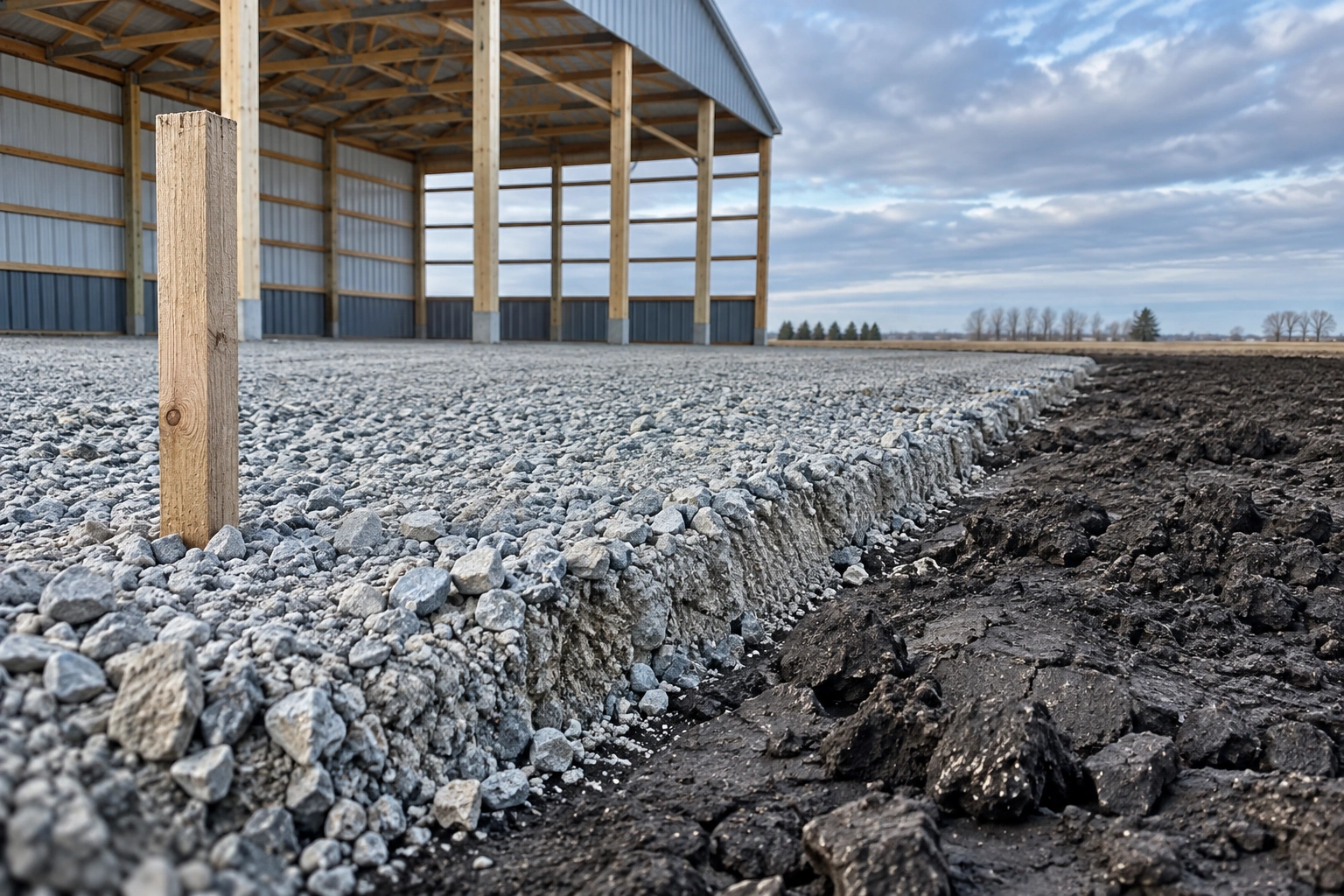
The practical differences on beach ridge ground are worth spelling out. Augering is easier and more predictable. Bearing at footing depth is generally better. Site access holds up in conditions that would stop work on the valley floor. And building pads frequently need less imported fill, because the native material already drains.
The trade-off is variability. Beach ridge deposits are not uniform, and gravel lenses, sand pockets and clay layers can all appear within a short distance. That is why bearing gets checked in every bore rather than extrapolated from the first.
How we build in Barnesville
- Better bearing, still verified
Beach ridge ground is generally good, and it is also variable. Every bore still gets checked.
- Clay County loads applied
50 psf ground snow load under Minnesota Rules 1303.1700.
- Slope used for drainage
Rolling ground means genuine fall, which makes drainage design straightforward rather than a fight.
- Land Alteration Permit considered
Steep slope provisions have a lower threshold, and some beach ridge ground qualifies.
Local conditions and figures
Barnesville is on the I-94 and US 52 corridor with MN 9 and MN 34 also serving the town, which makes delivery and access straightforward. It is home to the Clay County Fairgrounds and it has kept a working agricultural economy around it rather than becoming purely a commuter town.
The snow load is the same 50 psf that applies across Clay County, which is higher than the Cass County figure. On the more exposed rolling ground here, drift behaviour differs from the flat valley too, and any building with a step in its roof line gets the drift case calculated rather than assumed.
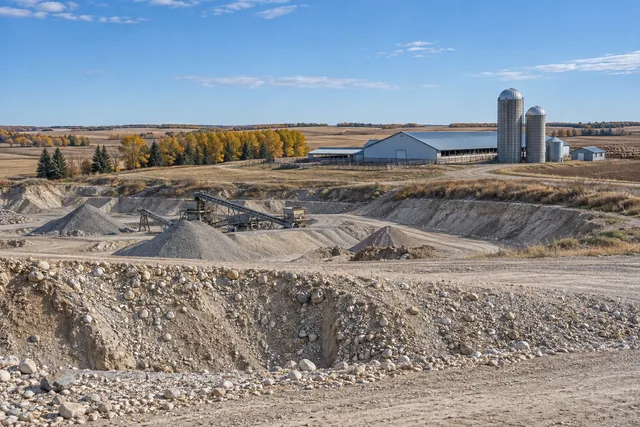
Gravel extraction has been part of the local economy along the beach ridges for a long time, which is a direct consequence of the same geology that makes the ground good to build on. In practical terms it means suitable granular material is generally available close by, and haul distance is one of the larger variables in any site preparation line. It is one of the few places locally where that line comes in lower than people expect.
How a Barnesville build runs
- Step 01Site assessment
Levels, slope, native material and drainage direction established, with the zoning district confirmed.
- Step 02Design to Clay County loads
50 psf ground snow load with drift cases, and energy compliance where the building is heated.
- Step 03Foundations
Holes to 60 inches with bearing inspected in each bore, footings placed and columns set.
- Step 04Frame and finish
Structure, roof, cladding and the interior work, with concrete poured under cover.
Before a Barnesville build
Beach ridge ground is kinder, and it still needs assessing.
- Let us see the native material
Where the ground already drains, the pad often needs less imported fill, which is a real saving on the most variable line in any quote. That is a site visit conclusion, not a desk one.
- Note any steep ground
Clay County's Land Alteration Permit threshold drops to 10 cubic yards on steep slopes and in shore-impact zones, and some beach ridge ground qualifies.
- Work out the slope you want to build across
Rolling ground gives you drainage for free and makes levelling a pad more involved. Both are worth designing for rather than discovering.
- Confirm the zoning district
Most of the surrounding townships are Agricultural General, but the Agricultural Service Center districts have their own provisions including a limit on private garage and storage building size.
Questions we get asked in Barnesville
Is building easier on the beach ridge than in the valley?
Generally yes. The ground drains, it carries machinery better, bearing at footing depth is usually good and pads often need less imported fill. The offset is that beach ridge deposits are more variable, so bearing gets checked in every bore rather than assumed.
What snow load applies in Barnesville?
50 psf ground snow load, as it is throughout Clay County under Minnesota Rules 1303.1700. Roof snow load is calculated from that under ASCE 7, with drift and unbalanced cases checked separately.
Do I still need a raised building pad?
Usually yes, though frequently less of one. Even on well-draining ground you want the building above the surrounding grade with a route for water to leave. The difference is that you are working with the slope rather than creating it.
How deep do the footings go?
60 inches below finished grade, under Minnesota's frost protection requirements for this part of the state.
Do you work on the farms around Barnesville?
Yes. Over 90 percent of Clay County is zoned Agricultural General and most of our work here is on working farms and acreages rather than in town.
Are Barnesville quotes free?
Yes, and on beach ridge sites the visit is useful because native material varies considerably and it affects how much fill the pad actually needs.
Is gravel cheaper here because of the local pits?
Haul distance is one of the larger variables in any site preparation line, so being close to a source genuinely helps. The bigger saving is usually that beach ridge ground drains on its own, so the pad often needs less imported material in the first place. Both show up in the same line of the quote, and we would rather show you the figure than describe it.
Does the Land Alteration threshold change on sloping ground?
Yes, and beach ridge ground is exactly where it bites. The general threshold is more than 50 cubic yards of material, but on steep slopes and within shore and bluff impacted zones it drops to more than 10 cubic yards. On rolling ground around Barnesville that lower figure is reached far sooner than people expect.
Everything we build in Barnesville
Everything here is available around Barnesville. Beach ridge ground tends to make the site preparation easier rather than changing the building, so the full range applies.
- Agricultural Pole Barns
- Horse Barns & Equestrian Buildings
- Machine Sheds & Equipment Storage
- Livestock Barns
- Hay Storage Buildings
- Pole Barn Garages
- RV & Boat Storage Pole Barns
- Pole Barn Workshops
- Commercial Pole Barns
- Hobby Shops & Man Cave Pole Barns
- Pole Barn Construction
- Pole Barn Design & Planning
- Pole Barn Foundation & Concrete Work
- Pole Barn Framing
- Pole Barn Roofing Installation
- Pole Barn Siding Installation
- Pole Barn Electrical Rough-In
- Pole Barn Insulation Installation
- Pole Barn Repair
- Pole Barn Renovation & Additions
- Post-Frame Building Construction
- Insulated Pole Barns
- Pole Barns with Living Quarters (Barndominiums)
- Custom Pole Barn Doors & Windows
- Pole Barn Loft & Second-Story Additions
- Metal Roof Pole Barns
- Wood-Sided Pole Barns
- Pole Barn Ventilation Systems
- Pole Barn Site Prep & Grading
- Pole Barn Snow Load Reinforcement
Building around Barnesville
Tell us the parcel and what you want on it. Ground here is usually kinder than the valley floor and the quote will reflect it.